

Quick answer: Generations describe tube technology, not quality. In 2026, an autogated Gen 2+ white-phosphor tube is the civilian sweet spot — our PVS-14 costs $1,749.95 sold direct — one supply-chain layer instead of four — versus about $2,795 for AGM's comparable unit and $4,500–7,000+ for Gen 3 units from L3Harris or Elbit. Judge any tube by its FOM number, not its generation label.
Every night vision listing leads with a generation number, and almost none of them explain what it means. The label is real — it describes the technology inside the tube — but sellers lean on it because it sounds like a report card. It isn't. Here is what each generation actually is, what it costs in 2026, and the one number that predicts image quality better than any of them.
There is a second thing the listings lean on, and it is harder to see than the label: the supply chain. Most night vision sold in the US passes from the factory through a distributor, a regional rep, and a storefront before it reaches a buyer, and each layer's margin pays for shelf space, financing terms, and the storefront itself — none of it improves the tube. When two units wear the same generation label at very different prices, the gap is usually that chain, not the glass. Our breakdown of PVS-14 dealer pricing traces it dollar by dollar.
What do night vision generations actually mean?
A generation describes the image-intensifier tube technology inside an analog device — how it converts photons into a visible image. It is a technology category, not a quality score: individual tubes vary widely within every generation.
Analog night vision works by intensifying ambient light. Photons enter the objective lens, strike a photocathode, become electrons, get multiplied, and land on a phosphor screen that glows where they hit. Each generation changed how the multiplication happens. That is the entire system — which means two tubes of the same generation can perform very differently depending on how well each one was built. Keep that in mind through everything below. For a wider map of the technology families, our types of night vision guide covers the full landscape.
What is Gen 1 night vision, and what are those $200 scopes?
Gen 1 is 1960s-era intensification: dim output, fishbowl distortion at the edges, heavy dependence on an IR illuminator, and tube life around 1,500 hours. The $200 "Gen 1" scopes sold online in 2026 are exactly that — legacy technology.
Gen 0 came first: WWII-era systems that only worked with a large active IR spotlight. Gen 1 (Vietnam era) amplified ambient light for the first time by chaining vacuum tubes together, which made units long, dim, and distorted. Modern Gen 1 devices are honest products for what they are — backyard wildlife watching on a bright-moon night, a first taste of the hobby — but they are not comparable to a modern tube. Most need their IR illuminator switched on almost constantly, which means they are emitting light rather than passively observing. Some products in that price bracket are actually digital sensors wearing a "night vision" label; more on where digital genuinely fits below.
What is Gen 2+ night vision, and why is it the civilian sweet spot in 2026?
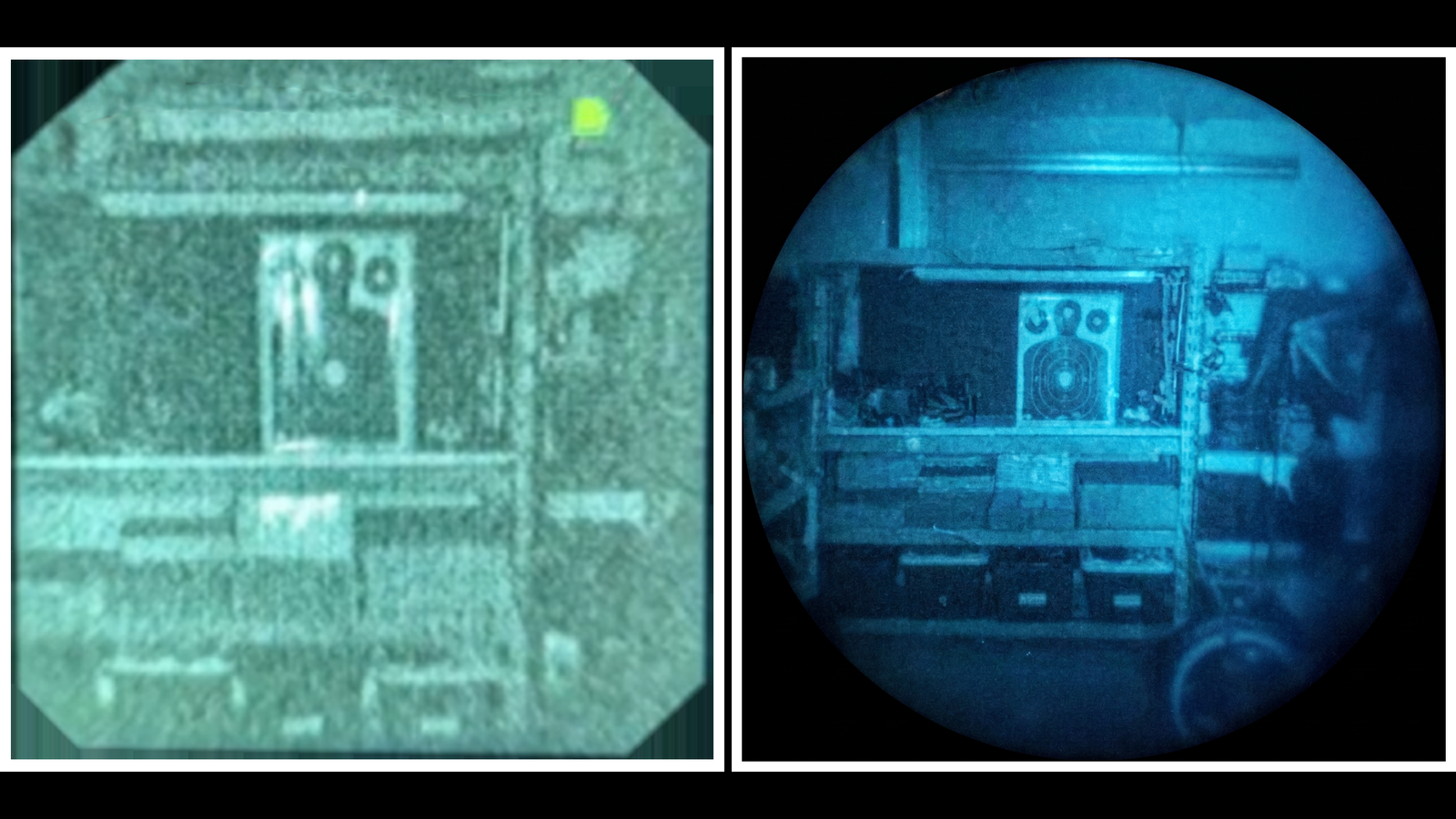
Gen 2 added the micro-channel plate — a wafer of millions of microscopic tunnels that multiplies electrons thousands of times. Modern Gen 2+ autogated white-phosphor tubes resolve 64–72 lp/mm, and as of July 2026 they are the civilian sweet spot.
The micro-channel plate was the breakthrough that made night vision genuinely passive: bright, sharp images from starlight alone, no illuminator required. "Gen 2+" means the refined version of that design — better photocathodes, better glass, and in current production, autogating (which protects the tube from sudden bright light) and white phosphor (which most eyes read with more contrast than green). This is what "real night vision" means when people say it: an analog Gen 2+ intensifier tube, zero latency, no screen between you and the scene.
It is also where the price-to-performance math lands for civilians — provided the supply chain has not eaten the advantage. We sell one supply-chain layer deep, so our PVS-14 with a Gen 2+ autogated white-phosphor tube costs $1,749.95; AGM's PVS-14 NW2 costs about $2,795 and ATN's PVS14-2 about $2,609 for the same technology class. The subtraction is worth doing once: $2,795 at AGM minus $1,749.95 direct = about $1,045 that bought you nothing but the dealer's storefront. The difference is not the tube — it is how many hands the unit passes through before it reaches you.

Our pick for most first-time buyers: an autogated Gen 2+ white-phosphor monocular covers hunting, land monitoring, and night navigation under the light conditions civilians actually work in. Night Operators PVS-14 — $1,749.95. Free G24 helmet mount included, 1-year warranty.
What is Gen 3, and when is it genuinely worth $4,500+?
Gen 3 swaps the photocathode for gallium arsenide, which is more sensitive in near-zero light. Complete units from L3Harris or Elbit channels cost $4,500–7,000+ in 2026 — government and professional tier.
We will be straight about this, because it is brand policy: if your work involves true zero-ambient environments — moonless nights under triple canopy, unlit interiors, professional operations where failure is not an option — buy Gen 3. The gallium-arsenide photocathode holds a real sensitivity edge at the darkest end of the scale, and that tier of tube is built, tested, and priced for buyers who exhaust it. We do not compete there and do not pretend to.
What we will also say: that advantage narrows sharply under starlight and moonlight, which is where nearly all civilian use happens. Hunting, land monitoring, night hikes, camping, airsoft — a quality Gen 2+ tube covers all of it. Paying Gen 3 money to walk your property under a half moon is buying capability you will not use. The full head-to-head lives in our Gen 2 vs Gen 3 comparison, which is the right next read once you have the basics from this page.


Is there such a thing as Gen 4 night vision?
No — there is no official Gen 4. The US Army briefly applied the term to filmless tubes in the early 2000s, then withdrew it. Anything sold as "Gen 4" in 2026 is a marketing label; ask for the FOM number instead.
Filmless and thin-filmed tubes are real engineering improvements, but the standards body never ratified a fourth generation, so the term has no fixed meaning. In practice, "Gen 4" on a product page tells you about the seller, not the tube. A seller confident in their glass will hand you measured numbers: resolution, signal-to-noise ratio, FOM, blemish map. A seller leaning on an unofficial label usually will not.
Why does FOM predict image quality better than the generation label?
FOM (Figure of Merit) is resolution in lp/mm multiplied by signal-to-noise ratio — a measurement of the individual tube, not its category. A high-FOM Gen 2+ tube outperforms a tired or low-spec Gen 3 tube.
This is the single most useful thing to take from this article. Generation tells you how a tube works; FOM tells you how well a specific tube actually performs. A Gen 2+ tube at FOM 1600–1800 delivers a cleaner, sharper image than a worn Gen 3 tube that has burned through its best hours — generation label be damned, the photons do not care. It is why we publish a per-tube QC sheet with every unit: serial, resolution, SNR, FOM, and blemish map for the exact tube in your box, so you compare measured numbers instead of category labels. The full breakdown of what the number means at each tier is in what FOM means in night vision.
Where does digital night vision fit into the generation system?
It doesn't. Digital night vision uses a CMOS sensor and a display instead of an intensifier tube, so generation ratings do not apply. Our VIPER costs $249.95 and is the entry point for digital; analog Gen 2+ is what "real night vision" means.
Digital devices capture light on a sensor and show you a screen — the same principle as a camera in night mode, engineered for low light. The good ones do what most civilians use night vision for: spotting wildlife, checking a property line, recording what they see. What they do not do is match the analog experience — a digital image arrives with sensor latency and display resolution limits, while an analog tube is pure optics with zero delay. Consumer digital units from SIONYX and similar brands cost $300–600; the VIPER costs $249.95 through the same single-layer direct chain — a true 1× lens and built-in IR — and is our take on that category. If you are weighing the two technologies seriously, digital vs analog night vision walks through the trade honestly.
Which generation should you buy in 2026?
Most civilians: an autogated Gen 2+ white-phosphor unit — our PVS-14 costs $1,749.95 direct with a per-tube QC sheet, about $1,045 less than AGM's $2,795 equivalent. Professionals working in zero ambient light: buy Gen 3 and pay its price.
| Generation | Technology | Typical price in 2026 | Who it's for |
|---|---|---|---|
| Gen 0 / Gen 1 | Vacuum-tube intensification, IR-dependent, short tube life | $150–400 | Novelty use, bright-moon backyard viewing |
| Gen 2 / Gen 2+ | Micro-channel plate; modern tubes autogated, white phosphor | $1,749.95–3,000 | Most civilians: hunting, land monitoring, night navigation |
| Gen 3 | Gallium-arsenide photocathode, highest zero-light sensitivity | $4,500–7,000+ | Professional zero-ambient work, government channels |
| "Gen 4" | No official standard — marketing label | Varies | Nobody — ask for the FOM number instead |
| Digital NV | CMOS sensor + display; not generation-rated | $249.95–600 | Entry digital buyers: observation, recording |
One more filter outranks the generation question entirely. Whoever you buy from — us included — run this three-point check first:
- Measured specs in writing, per unit. A seller who prints resolution, SNR, and FOM for your specific tube is selling you glass. A seller who prints a generation number in a big font is selling you a label.
- Autogating and white phosphor confirmed. Both are current-production standard on quality Gen 2+ tubes in 2026; a listing that dodges either question has answered it.
- Warranty and paperwork. Marketplace listings ask $2,500–$3,100 for used PVS-14s with blemished tubes, no warranty, and no records, while a new unit with a measured per-tube QC sheet costs $1,749.95 direct. A used tube without numbers is the generation-label problem all over again — a story in place of a measurement.
Frequently asked questions
Is Gen 4 night vision real?
No. There is no official Gen 4 standard. The US Army briefly used the term for filmless tubes in the early 2000s and then withdrew it. Treat any "Gen 4" listing as marketing and ask the seller for the tube's FOM number.
Is Gen 2+ good enough for hunting and land monitoring?
Yes. A modern autogated Gen 2+ white-phosphor tube performs well under starlight and moonlight, which covers hunting, land monitoring, and night navigation. Gen 3 only earns its price in near-total darkness.
How much does Gen 3 night vision cost in 2026?
Complete Gen 3 units from L3Harris or Elbit channels cost $4,500 to $7,000+ as of July 2026. That tier is built for government and professional buyers, and the pricing reflects that channel.
What generation is digital night vision?
None. Digital night vision uses a CMOS sensor and a display instead of an intensifier tube, so generation ratings do not apply. Compare digital units by sensor resolution, latency, and low-light performance instead.

If you have landed on Gen 2+ — and for most buyers in 2026 that is the honest answer — the Night Operators PVS-14 Gen 2+ autogated white-phosphor monocular costs $1,749.95 direct because there is no dealer layer to feed. Each unit is made to order and ships with the measured QC sheet for your specific tube, the free G24 helmet mount is included with every order so it arrives helmet-ready, and it carries a 1-year manufacturer warranty with worldwide shipping, duties pre-paid — 17,000+ orders shipped since 2023. See the PVS-14 here.