

Quick answer: Not in absolute darkness — and anyone who says otherwise is selling a myth. Analog night vision multiplies existing starlight or moonlight; with literally zero photons there is nothing to multiply. Digital night vision hits the same wall sooner and leans on an IR illuminator. Only thermal imaging works in true zero light, because it reads heat instead of light. The practical news: real zero-light conditions are rarer than you think, and a Gen 2+ PVS-14 ($1,749.95) runs happily on starlight alone.
What does night vision actually need to work?
Photons. An analog image intensifier — the technology inside our PVS-14 — takes whatever light the sky provides, converts it to electrons, multiplies the stream through a microchannel plate, and paints the result on a phosphor screen. Starlight alone, on a clear moonless night, is enough for a Gen 2+ autogated tube to render a field you could walk confidently.
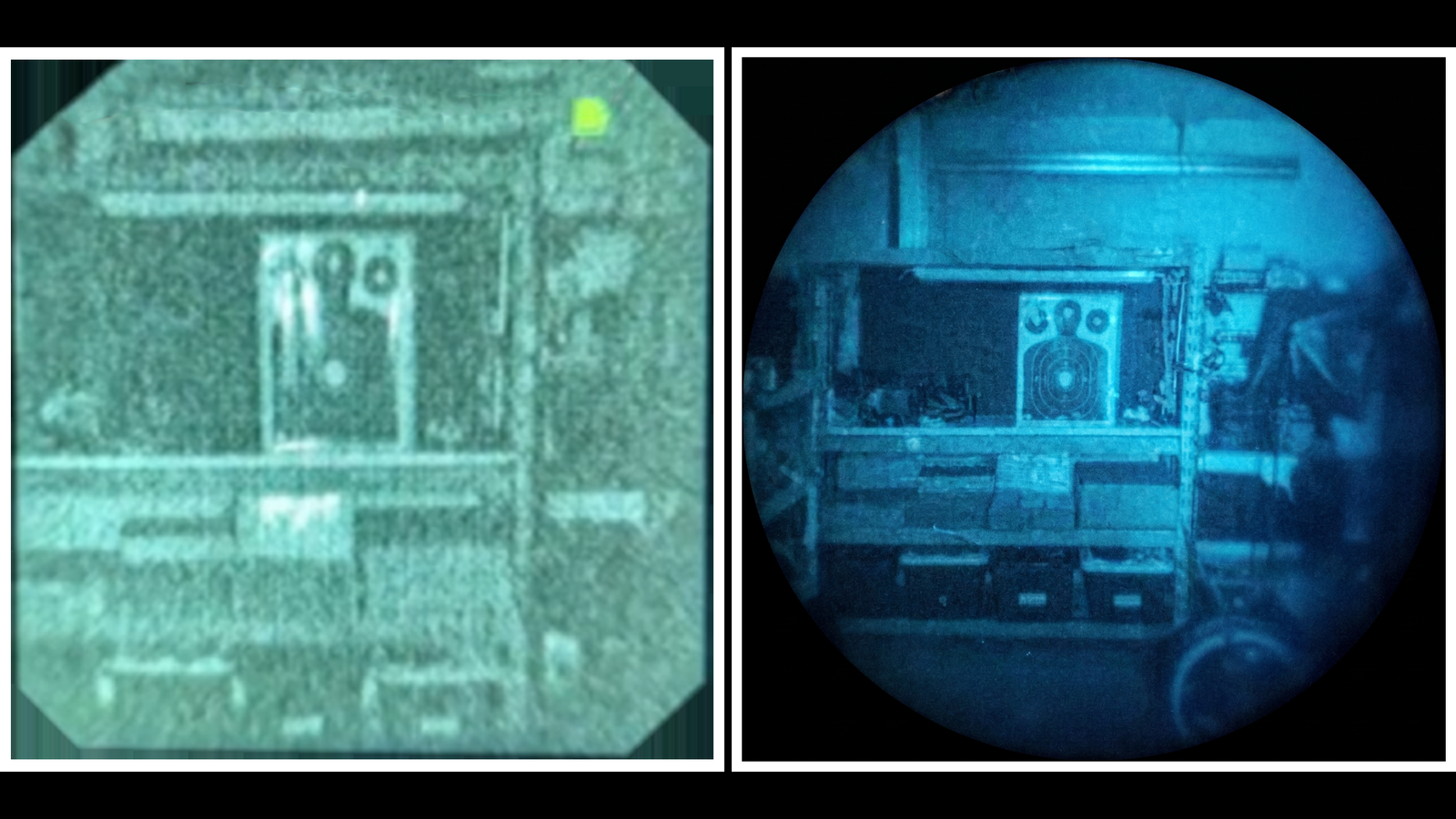
That footage above is not a simulation — it is our own tube filmed under nothing but a moonlit sky. The image is bright because the tube multiplied faint light tens of thousands of times, not because the scene was lit.
So the precise answer to the title question: night vision works in every darkness that still contains some light — which outdoors, under open sky, is almost every night of the year. Where it cannot work is the darkness that contains none.
Where does true zero-light darkness actually happen?
Fewer places than the marketing suggests, but they are real: interior rooms with no windows, basements, dense forest canopy under storm cloud, caves, and enclosed structures at night. In those spaces an analog tube has nothing to amplify and a digital sensor has nothing to read. Two tools cover the gap:
IR illumination. An infrared torch floods the scene with light your eye cannot see but the device can. Our VIPER digital monocular carries a built-in 850nm torch for exactly this reason — indoors and at close range it simply turns the lights on, invisibly.

Thermal. A microbolometer does not care about light at all. In a sealed black room, a warm body still radiates heat, and our HEAT thermal monocular ($649) renders it at full strength. That is not night vision working in darkness — it is a different physics entirely, covered in does thermal vision work in total darkness.

Which myths deserve to die?
| Myth | Reality |
|---|---|
| "Night vision sees in total darkness" | Light-based night vision needs at least starlight; zero photons means zero image without IR help |
| "Night vision sees through walls" | Nothing on this page sees through walls - not tubes, not sensors, not thermal |
| "The image looks like daylight" | A good tube renders remarkable detail, but it is a monochrome phosphor image with its own texture - real footage above, judge yourself |
| "Thermal is night vision" | Thermal reads heat, performs no light intensification, and works at noon exactly as at midnight - different tool, different job |
| "More expensive always means more capable" | Past the sensor and tube class, price mostly buys ruggedization and the dealer chain - measured specs beat logos |
Analog, digital, or thermal for dark conditions — which should you buy?
Map the device to the darkness you actually face:
Open sky, most nights: analog wins outright. A Gen 2+ autogated white-phosphor PVS-14 at $1,749.95 turns starlight into a walkable image with zero display lag and no IR signature. Every unit ships with its tube's measured resolution, signal-to-noise and FOM on a per-unit QC sheet — the honest way to buy a tube, explained in what FOM means.
Close range, indoors, lower cost of entry: digital plus IR. The VIPER at $249.95 with its built-in torch covers property checks and camp use for a fraction of analog money — the trade-offs are spelled out in digital vs analog.
True zero light, or finding warm bodies: thermal. The HEAT at $649, or both spectrums at once with the HEAT + VIPER Bridge kit at $749 complete.
Our pick for most buyers asking this question: the PVS-14 — because the darkness you actually operate in almost always has starlight, and a real Gen 2+ tube uses it better than any sensor. PVS-14 — from $1,749.95. Free G24 helmet mount included, 1-year warranty, per-tube QC sheet.
One artifact from our own history makes the digital-side point better than we could: the original creative below sold the first Night Operators dual-mode kit on exactly this "darkness has layers" argument.

Frequently asked questions
Do night vision goggles work with no light at all?
No. Light-amplifying night vision — analog or digital — needs at least faint ambient light such as starlight. In absolute zero-light spaces it needs an IR illuminator, or you need thermal imaging, which reads heat instead of light.
How dark is too dark for a PVS-14?
Under open sky, almost never too dark: a Gen 2+ autogated tube produces a usable image from starlight alone. The practical limits are enclosed zero-light spaces — windowless interiors, caves, storm-covered canopy — where an IR illuminator restores the image.
Is an IR illuminator visible to other people?
Not to the naked eye — 850nm is invisible to humans, though a faint red glow at the emitter can be seen up close. Through any other night vision device, an active IR torch is as obvious as a flashlight, which is worth knowing before you rely on it as stealth.
What actually works in a completely sealed dark room?
Thermal imaging, or night vision with an IR illuminator switched on. A thermal sensor like the HEAT's reads emitted heat and needs no light; an IR torch supplies invisible light for a tube or sensor to amplify.
The nights you care about have starlight in them, and a real tube turns starlight into terrain — sold direct with the tube's measured numbers documented on paper. Every order includes a free G24 helmet mount and a 1-year manufacturer warranty, we ship worldwide with duties pre-paid, and 17,000+ orders have gone out since 2023. The PVS-14 starts at $1,749.95.