

Quick answer: The three types of night vision are image intensification (an analog tube multiplies existing light — the PVS-14, from $1,749.95), active illumination (a digital sensor plus an invisible IR torch — the VIPER, $249.95), and thermal imaging (a sensor reads emitted heat — the HEAT, $649). Each solves a different darkness; this guide shows real footage of all three, and night vision vs thermal imaging goes deeper on the light-vs-heat split.
Type 1: What is image intensification?
Image intensification is the original night vision and still the reference standard. A photocathode converts incoming photons to electrons, a microchannel plate multiplies them tens of thousands of times, and a phosphor screen turns the amplified stream back into visible light. No sensor, no display, no lag — the image is optics end to end, which is why it is the only type we call real night vision.

Performance lives in the tube, and tubes are measured, not marketed: resolution in lp/mm times signal-to-noise gives the FOM number that actually predicts what you will see (full explainer in what FOM means). Our PVS-14 runs Gen 2+ autogated white-phosphor tubes from $1,749.95, each shipped with its own measured QC sheet, with FOM tiers up to 1800. The dual-tube version of the same physics is the PVS-31 PRO from $3,799.95.
Type 2: What is active illumination?
Active illumination pairs a light-sensitive sensor with its own light source — an infrared torch invisible to the naked eye. The sensor sees a lit scene; bystanders see nothing. It is the technology inside consumer digital night vision, security cameras with IR LEDs, and our VIPER ($249.95), which carries a built-in 850nm torch.

The honest trade: the illuminator is a beacon to anyone else with night vision, and range is capped by torch power — think close-range property checks, camp chores, and indoor spaces rather than long fields. Game animals cannot see 850nm worth mentioning, so for wildlife watching the caveat rarely matters. When the torch does matter and when it does not is the whole subject of do you need an IR illuminator.
Type 3: What is thermal imaging?
Thermal abandons light entirely. A microbolometer reads the infrared heat every object emits and maps temperature differences into an image — warm bodies bright, cool ground dark. It works in absolute zero light, through light fog, and against camouflage, because none of those things change an animal's temperature.

Strictly speaking thermal is not night vision at all — it performs no light intensification — but it earns its seat in every three-type list because it owns the conditions where the other two struggle. Our HEAT carries a 296×192, 12µm, 25mK microbolometer at 60Hz for $649: the same sensor class as tactical thermals at four times the price, minus the dealer chain.
How do the three types compare side by side?
| Image intensification | Active illumination | Thermal imaging | |
|---|---|---|---|
| Reads | Ambient light, multiplied | IR light it brings along | Emitted heat |
| Needs light? | Starlight is enough | No - makes its own | No - ignores light entirely |
| Detail | Highest - true optics, zero lag | Good at close range | Shapes and heat, little surface detail |
| Weakness | Sealed zero-light spaces | Torch visible to other NV; range-capped | Cannot identify or read terrain well |
| Our device | PVS-14, from $1,749.95 | VIPER, $249.95 | HEAT, $649 |
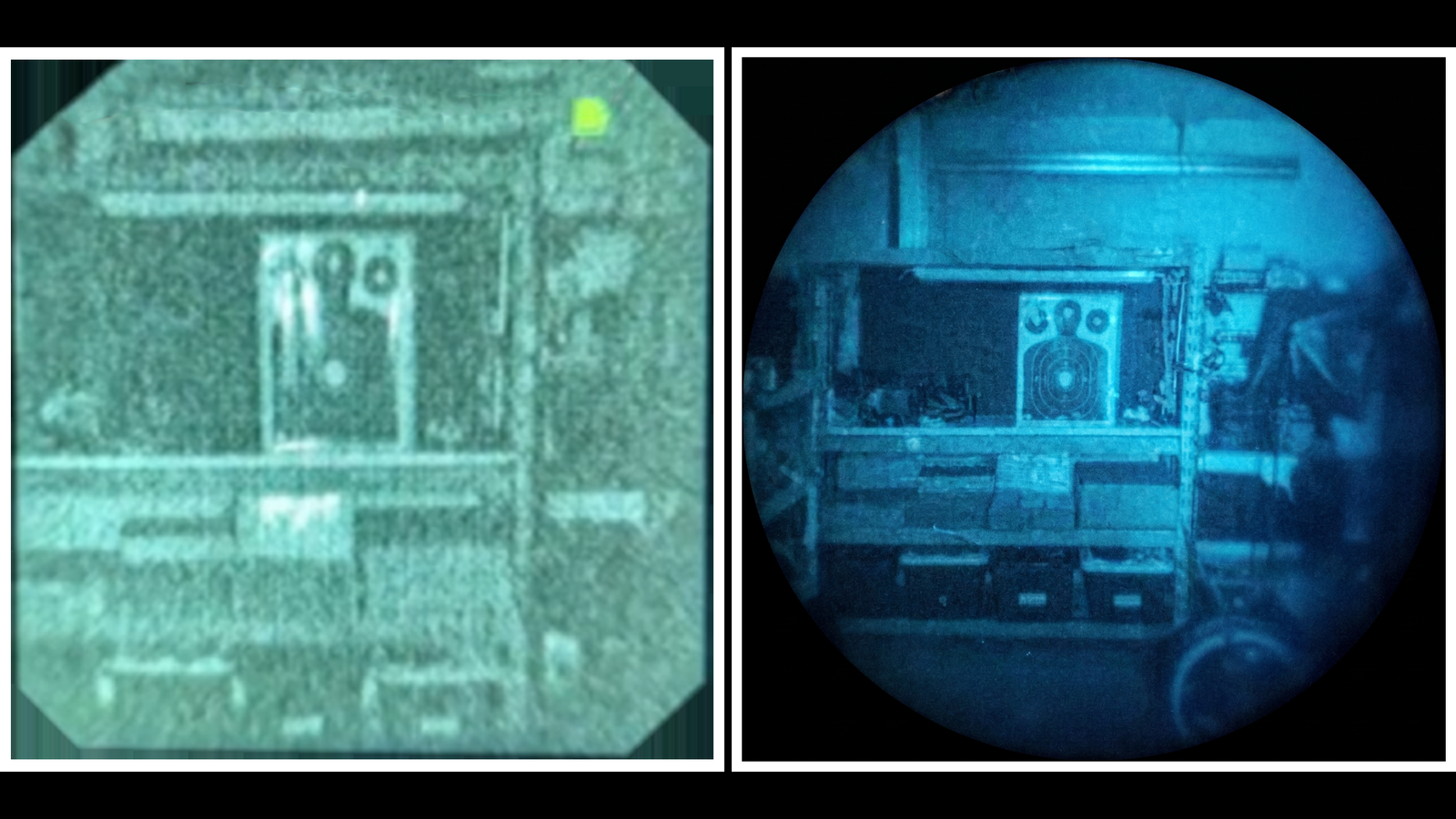
Fun fact from our own shelf: before the analog line became the flagship, Night Operators was built on types two and three — the original creative below is how we introduced the idea of switching between them.

Which type should you actually buy?
Buy image intensification if you want the definitive night image and plan to move through terrain: the $1,749.95 PVS-14 is the one device on this page that renders starlit ground well enough to walk it confidently. Buy active illumination if you are new to night optics or the job is close-range: at $249.95 the VIPER is the lowest-commitment entry that still does real work. Buy thermal if the job is finding warm bodies: $649 on the HEAT ends hide-and-seek permanently. And if the job splits across types — most do — the HEAT + VIPER Bridge kit runs types two and three side-by-side for $749 complete.
Our pick if you only buy one: the PVS-14. Types two and three each own a niche; a real Gen 2+ tube owns the night. PVS-14 — from $1,749.95. Free G24 helmet mount included, 1-year warranty, per-tube QC sheet.
Frequently asked questions
What are the three types of night vision?
Image intensification (an analog tube multiplies existing light), active illumination (a digital sensor paired with an invisible IR torch), and thermal imaging (a sensor that reads emitted heat). They solve different problems and are often used together.
Which type of night vision do professionals use?
Image intensification is the professional standard wherever moving through terrain matters, because it delivers the most detail with zero lag. Thermal rides alongside it for detection. Consumer digital devices fill the entry tier.
Is digital night vision one of the three types?
Digital night vision is the modern form of active illumination: a CMOS sensor does the seeing and an IR torch supplies invisible light when ambient light runs out. Without its torch, in very low light, a digital device falls behind an analog tube quickly.
What do the three types cost in 2026?
As of July 2026 at Night Operators: image intensification from $1,749.95 (PVS-14, Gen 2+ autogated white phosphor), active illumination $249.95 (VIPER digital with built-in 850nm IR), thermal $649 (HEAT, 12µm 25mK), or thermal plus digital together for $749 complete (HEAT + VIPER Bridge kit).
Whichever type your nights call for, buy it on measured numbers, not category labels — sold direct with one supply-chain layer instead of four. Every order includes a free G24 helmet mount and a 1-year manufacturer warranty, we ship worldwide with duties pre-paid, and 17,000+ orders have shipped since 2023. The PVS-14 starts at $1,749.95.