



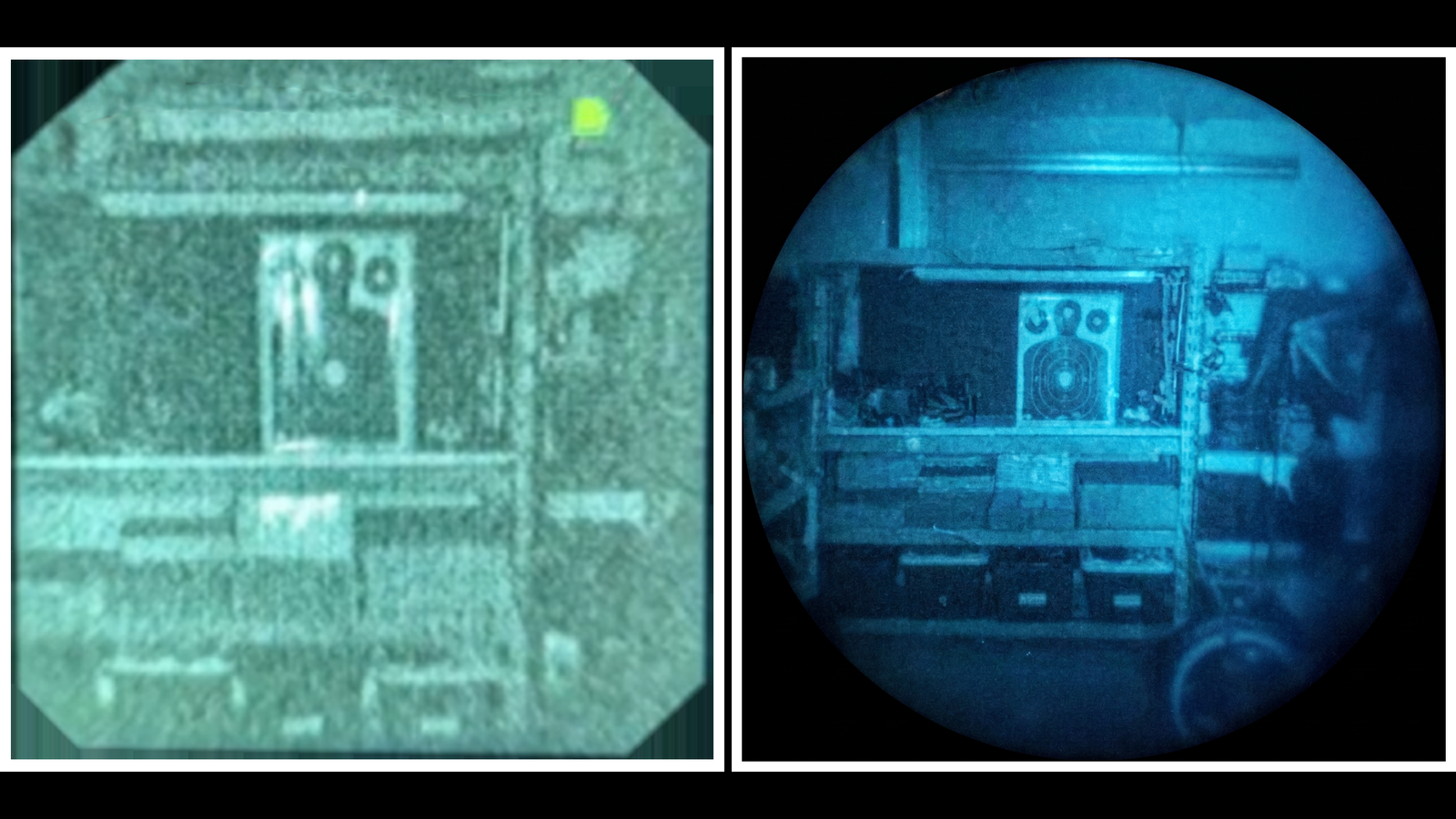
Quick answer: Digital night vision (a CMOS sensor plus a screen) does what most people need at night for $249.95; analog night vision (a Gen 2+ image-intensifier tube) delivers a categorically better low-light image with zero lag from $1,749.95. Digital is the entry point, analog is the destination — and we reserve the term real night vision for the tube, because in deep darkness the sensor is not in the same sport.
What is the actual difference under the housing?
Digital is a camera engineered for the dark: a low-light CMOS sensor captures the scene, electronics process it, and a small display shows it to your eye. Our VIPER is the reference example — 1.54" 320×320 display at 60 FPS, built-in 850nm IR torch, $249.95 as of July 2026.
Analog has no sensor and no screen. Photons strike a photocathode, become electrons, are multiplied tens of thousands of times through a microchannel plate, and land on a phosphor screen as visible light. The image is physics end to end: no processing, no latency, no display pixels between you and the scene. That is what is inside our PVS-14, from $1,749.95 with a Gen 2+ autogated white-phosphor tube.

Where does each one win?
| Factor | Digital (VIPER, $249.95) | Analog (PVS-14, from $1,749.95) |
|---|---|---|
| Deep-darkness performance | Needs IR help early | Runs on starlight alone |
| Image latency | Sensor-to-screen delay, small but real | Zero - light-speed optics |
| Bright-light tolerance | Shrugs it off - sensors don't burn | Autogating protects the tube, but daylight is not its habitat |
| Recording and sharing | Native - it is already a camera | Not without add-ons |
| Cost of entry | $249.95 | $1,749.95 |
| The image itself | Good screen picture | The reference - detail, depth, natural texture |
The hero image is both worlds, real footage, same class of dark night: digital's processed scene on the left, the tube's phosphor image on the right. Screens compress that difference — through the eyepiece, it is not close. The spec-level version of this story runs through generations and FOM: which generation should you buy and what FOM means carry it from here.
Is digital night vision worth buying at all, then?
Genuinely yes — and it would be dishonest funnel-building to say otherwise. For spotting movement at the fence line, watching wildlife, camp navigation, and learning what night optics feel like before four figures leave your card, the VIPER at $249.95 is exactly the right amount of device. It records what it sees, tolerates daylight, and its built-in IR torch handles close-range true dark that would starve any passive device (when IR matters is covered in do you need an IR illuminator, and what counts as too dark in can night vision work in total darkness).

What digital cannot do is close the deep-darkness gap. As light falls toward starlight-only, the CMOS sensor runs out of photons and reaches for its torch, while a Gen 2+ tube keeps rendering the field. The technologies do not converge at the bottom of the light curve — they diverge, and that bottom is precisely where night work happens.
Our own history tells the same story: we built this company on digital — the creative below is from that era — and then moved our flagship to analog because customers who started on sensors kept asking for the tube image.

What does the upgrade path look like in practice?
Most owners run it in this order: VIPER first ($249.95) to learn the night; HEAT beside it ($649) when finding warm animals becomes the job — or both at once in the bridge kit at $749 complete; then the PVS-14 ($1,749.95) when the image itself becomes the point. Nothing gets orphaned: the VIPER stays the loaner and recorder, the HEAT pairs with the PVS-14 for find-and-confirm, and the setup grows instead of churning.

Our pick if you are past the entry tier: go straight to the tube. Gen 2+ autogated, white phosphor standard, per-tube QC sheet, FOM tiers from 1250 to 1800. PVS-14 — from $1,749.95. Free G24 helmet mount included, 1-year warranty.
Frequently asked questions
Is digital night vision as good as analog?
In moderate low light and at close range, digital is respectable; in deep darkness it is not in the same category. A Gen 2+ tube runs on starlight with zero lag, while a CMOS sensor needs IR assistance — which is why analog remains the professional standard.
Why is analog night vision so much more expensive than digital?
The image-intensifier tube is genuinely hard to manufacture — vacuum physics, photocathodes, microchannel plates — and each tube's performance must be individually measured. A CMOS sensor is a mass-produced camera part. You are paying for the tube, which is also exactly what you are getting: ours ship with per-unit QC sheets.
Can digital night vision record video?
Yes — recording is digital's native advantage, since the device is already a sensor and processor. The VIPER records what it sees. An analog tube shows you the image live but needs added hardware to capture it.
Which should a first-time buyer choose in 2026?
If you want to stay under $300, the VIPER at $249.95 is the honest entry and teaches you what night optics do. If you already know your nights are serious, skip the intermediate step — the PVS-14 at $1,749.95 is the destination device, and it is where most committed users end up anyway.
Digital gets you into the night; the tube makes you at home in it. Buy the destination once instead of the detour twice — sold direct, with the tube's measured numbers on paper. Every order includes a free G24 helmet mount and a 1-year manufacturer warranty, we ship worldwide with duties pre-paid, and 17,000+ orders have shipped since 2023. The PVS-14 starts at $1,749.95.